

Curly Hair Salon Ottawa | Specialist Curly Cuts & Texture Styling Guide
Custom Dry Curl Cutting, Pattern Shaping (2A to 4C), Deep Hydration & Frizz Defense in a Private Ottawa Studio.
• 43 Five-Star Google Reviews from local Ottawa clients.
• 151 Five-Star Reviews on Booksy celebrating our personalized curl consultations and transformations.
Why Curly Hair Demands Its Own Approach (And Why Standard Cuts Fail)
Curly hair is more than a texture — it’s a structural pattern that demands its own approach. And more people in the city are discovering that a basic “regular” haircut is simply not enough. When curls are treated like straight hair, the outcome is almost always frustration: unpredictable shrinkage, awkward stair-stepped layers, and shapes that collapse the moment you wash your hair at home.
If you have naturally wavy, curly, or coily hair, you know the familiar salon disappointment. You walk into a typical salon where your hair is immediately washed, combed out straight with a fine-tooth comb under heavy tension, and cut straight across. It looks smooth when blown out with a round brush in the salon chair. But three days later when you do your own wash day, the reality appears: one side bounces up two inches higher than the other, your top layers sit like a shelf, and your hair forms the dreaded “Christmas tree triangle.”
This is why specialized curly hair cutting and styling education is rising so rapidly across Ottawa — clients want predictable, reproducible results, not temporary salon illusions that vanish with water. The fundamental rule is clear: curly hair needs a method, not a routine guess. Investing in a dedicated curly hair specialist in Ottawa transforms your relationship with your hair from a daily struggle into an effortless signature look.
At Hair Renos, our private Ottawa studio approaches curls through customized dry architectural sculpting. We don’t force your hair into an unnatural straight geometry. Instead, we study how your curls move, where they spring, how they clump, and how your separate curl families behave in their completely natural, dry state. The result is a haircut that falls into place effortlessly on wash day and looks just as balanced on day four.
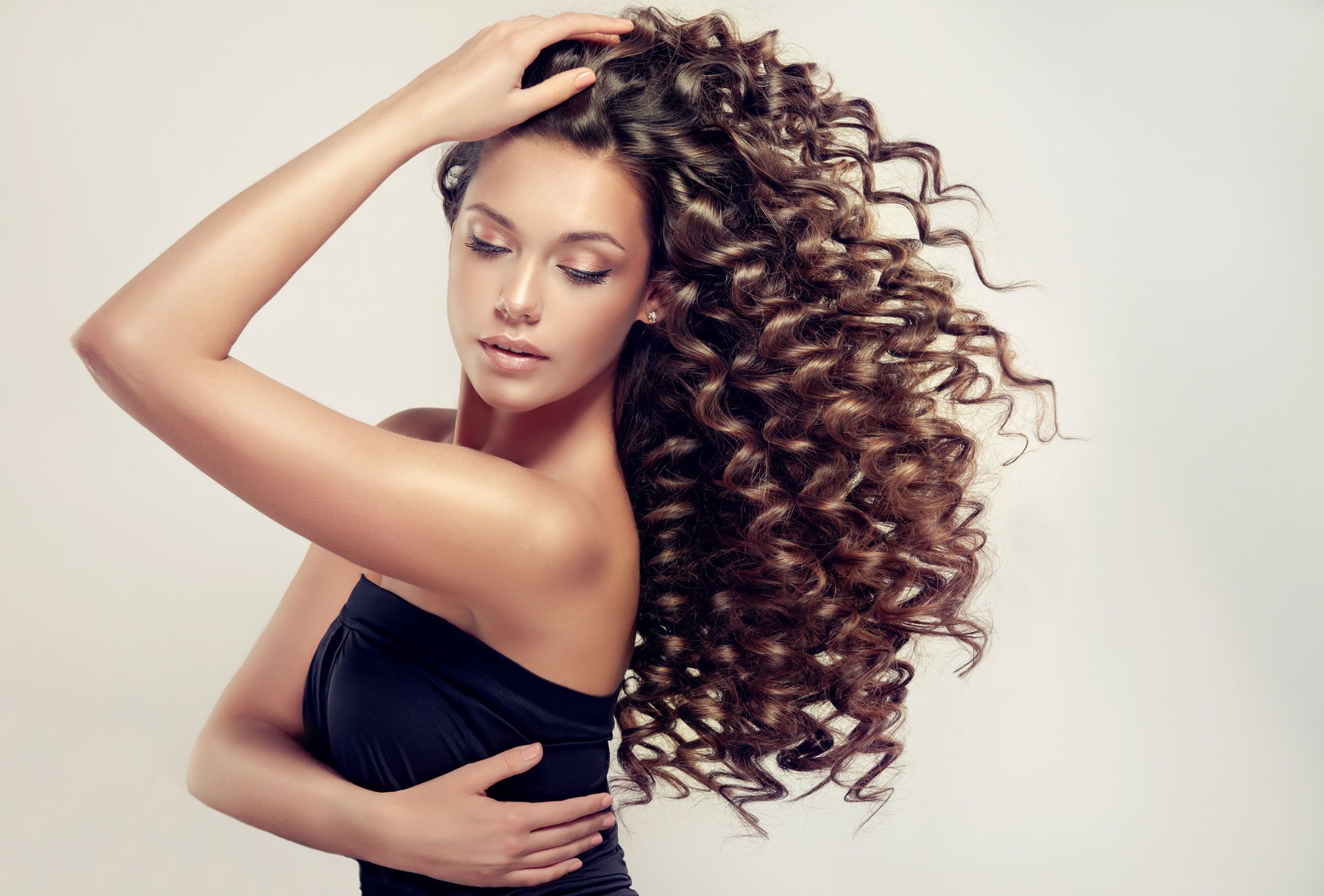
Ottawa Curly Hair Transformation
Why Your Curls Behave the Way They Do (The Everyday Science)
Have you ever wondered why straight-haired friends can wash their hair with almost any supermarket shampoo and have it stay shiny, while your curls seem perpetually thirsty no matter how many masks or conditioners you buy? It is not your fault, and you do not have “difficult hair.” Your hair simply operates under different physical and biological rules:
1. The “Spiral Staircase” Dryness
Your scalp produces natural protective oils (sebum) meant to keep your hair shaft conditioned and shiny. On straight hair, oil slides effortlessly down the strand like an open slide. On curly and wavy hair, every strand is a winding spiral staircase. Natural oils get trapped at the roots, leaving your mid-lengths and ends thirsty. Curls are not naturally damaged — they are simply naturally dehydrated and crave water-based moisture.
2. The “Slinky” Shrinkage Effect
Think of a curl like a metal slinky spring. When hair is wet, the weight of water pulls the slinky completely taut and straight. The moment water evaporates, that slinky springs back upward. Loose waves spring up 1 to 2 inches; tight ringlets spring up 3 to 4 inches; coily hair can shrink up to 6 inches! Cutting wet hair pulls that spring out, meaning the stylist has no idea where your ends will actually live once dry.
3. The Ottawa Mineral Trap
Tap water across Ottawa, Nepean, Kanata, and Barrhaven carries dissolved minerals like calcium, magnesium, and trace copper. Because curly hair cuticles are naturally raised along each bend, minerals latch on like velcro. This creates an invisible barrier that blocks fresh moisture from entering, causing curls to feel dry, stiff, and chalky. A gentle clarifying detox resets the hair completely.
Finding Your True Curl Pattern: The Spectrum from 2A Waves to 4C Coils
Curly hair exists in patterns — wave, loose curl, ringlet, coil — and each curl pattern contains its own relationship to moisture, product build, density, and weight. You do not need to fit into a rigid box, but identifying your primary curl family gives you the exact blueprint for what products to use, how much hold you need, and how your cut should be structured:
Type 2: The Wavy Patterns (2A, 2B, 2C)
Your hair forms gentle or defined “S” shapes. It typically lies flatter against the scalp near the crown and picks up texture around your cheekbones down through the ends.
- The Common Frustration: Waves are easily weighed down by heavy shea butters, thick creams, or silicone serums, which stretch the wave straight and make roots look oily.
- The Ideal Routine: Lightweight moisturizing leave-in sprays, weightless curl-defining foams, and diffusing upside-down for root elevation.
- The Cutting Strategy: Internal graduation and subtle weight-carving that frees up the canopy so waves can lift and spring freely.
Type 3: The True Curls & Ringlets (3A, 3B, 3C)
Your hair forms distinct spirals, corkscrews, and loopy ringlets with spring and elasticity. When stretched, strands snap right back into place.
- The Common Frustration: Noticeable shrinkage (30% to 50%) and the infamous “triangle silhouette” when weight sits squarely on the perimeter.
- The Ideal Routine: Generous leave-in moisture applied soaking wet in the shower, layered under a botanical gel that creates a smooth protective cast.
- The Cutting Strategy: Rounding the perimeter and carving tailored layers curl by curl so your spirals nest neatly together without a blunt bottom shelf.
Type 4: The Coils & Kinks (4A, 4B, 4C)
Your hair forms tight mini-corkscrews, angular “Z” zig-zags, or ultra-compact coils with gorgeous architectural volume and natural density.
- The Common Frustration: High shrinkage (often 60% to 75%), making hair appear much shorter than it is, combined with delicate cuticles prone to mechanical friction.
- The Ideal Routine: The L.O.C. or L.C.O. method (Liquid, Cream, Oil), deeply hydrating butter-rich styling creams, gentle wide-tooth detangling, and satin bonnet protection.
- The Cutting Strategy: Pure dry visual silhouette sculpting. We shape the exterior perimeter and crown balance first to give your coils an intentional, flattering crown.
Over 80% of our Ottawa clients have two or three different patterns on their head! You might have loose Type 2 waves at your neck, tight Type 3B ringlets at your crown, and softer curls around your temples. Wet comb cutting treats all zones identically, resulting in uneven lengths. Dry architectural cutting respects each zone on its own terms.
The Vidal Sassoon Dry Cutting Difference: Architecture Built for Curls
Cutting curly hair wet often hides these realities. A wet curl looks longer, smoother, flatter, and visually deceiving. Once dried, the curl tightens back up — sometimes significantly — and lengths shift unpredictably. That’s why many trained curly specialists prefer dry cutting first, shaping curl by curl or section by section at the curl’s true natural resting point.
The objective is not to remove length for the sake of “lightness,” but rather to sculpt volume intentionally, balance density without weakening the curl, and create a controlled silhouette that enhances natural movement.
The Truth About Thinning Shears: Why We Never Use Them on Curls
Thinning curly hair often does the opposite of what the client wants — it often destroys curl grouping, increases frizz, and makes future styling harder, not easier.
Thinning shears (also known as texturizing shears) have serrated teeth that cut random chunks of hair along the strand. On straight hair, this reduces density smoothly. But on curly hair, every curl is a team of hundreds of strands working together to form a spiral. When thinning shears bite into a curl clump, they create thousands of tiny, disconnected short hairs trapped inside the bundle.
Those tiny short hairs act like jack-in-the-box springs: they push your outer curls outward, breaking the clump apart and turning your defined ringlets into an uncontrollable fuzzball of static frizz. You end up with hollow, frizzy ends and puffy, unmanageable roots.
At Hair Renos, we use our master Vidal Sassoon precision scissors to perform structural negative-space carving. We remove weight only from the dense bulk zones between your curl families. Your curl bundles stay completely intact, your ends stay full and healthy, and the heavy, dragging bulk disappears.
Vidal Sassoon Dry Precision

Styling & Wash Day Mastery: It’s All Technique, Not 20 Products!
Styling is the other piece of the success equation. Styling curly hair is not product-focused — it’s technique-focused. Ottawa curly hair stylists know that curls need water, conditioner, and well-layered products. Applying products to soaking-wet hair allows moisture retention, slip, and better curl grouping.
Sectioning is crucial — because most curly hair fails when product is randomly scrunched in instead of intentionally distributed. Clumping matters. Clumping is the visual grouping of curls into defined bundles — which becomes the final curl shape once dried. When clumps are consistent, healthy, and hydrated, they reflect light more, look glossier, and reduce frizz without needing heavy hold.
Step 1: The Soaking Wet Squish
Water is your ultimate moisturizer. Apply conditioner to dripping-wet hair in the shower. Use the “squish to condish” method: cup your hair in your palms and gently pulse upward toward your scalp. You should hear a squishy, squelching sound like walking through wet sneakers. That sound tells you water and conditioner are being locked deep inside the cuticle!
Step 2: Sectioning & Praying Hands
Never rub products randomly over the top of your head! Clip your hair up into 3 or 4 horizontal tiers. Work from the bottom up. Smooth your curl cream through each section using smooth “praying hands” down the length of the strands. Then gently shake your hands to let the curls snap into their natural clump families.
Step 3: Creating & Breaking the Cast
Glaze a water-soluble styling gel over your clumps to seal in hydration. As your hair dries, the gel creates a firm, crunchy shell (called a cast). This cast protects your curls from friction while drying. Once hair is 100% dry, gently scrunch out the crunch with clean hands to reveal pillow-soft, glossy, frizz-free curls!
Diffusing vs. Air Drying: Forming the Undisturbed Shape
Drying is the final step. Air drying is fine — but diffusing is transformative when done slowly, on low heat and low airflow, lifting curls in upward motion so that the curl forms its shape undisturbed. Gentle finishing scrunching once dry can break any cast and reveal softness, bounce, and definition.
| Drying Method | Airflow & Temperature | Volume & Bounce Effect | Best Suited For |
|---|---|---|---|
| Pixie Diffusing | Turn dryer OFF, cup ends, lift bowl up to scalp, turn ON low heat/low air for 60s, turn OFF before moving. | Maximum root elevation, tight bouncy spring, higher shrinkage. | Type 2 waves and 3A/3B ringlets wanting big, lifted volume. |
| Hover Diffusing | Hold diffuser 4–6 inches away from hair, slowly circling the head without physically touching curls until cast sets. | Zero friction disturbance, preserves length, sets cast with zero flyaways. | Type 3C and Type 4 coils prone to friction fuzz, or delicate curls. |
| Micro-Plopping + Air Drying | Gently squeeze excess water with a 100% cotton t-shirt or microfiber towel; allow hair to air dry untouched. | Elongated curl pattern, lower shrinkage factor, relaxed lived-in look. | Warm summer months and clients who prefer zero-heat styling. |
The Ottawa Climate Factor: Season-by-Season Curl Survival
Living in the National Capital Region means navigating some of the widest seasonal humidity and temperature swings in North America. A curl care routine that makes your curls look magnificent in July will fail completely in January unless adjusted for atmospheric moisture:
Winter Survival (-20°C & Radiator Heat)
Between November and March, Ottawa sub-zero outdoor air contains almost zero moisture, while indoor radiator heating drops indoor humidity levels below 20%. Under these conditions, products rich in simple humectants (like high-dose glycerin) will reverse direction: because the air is drier than your hair, glycerin pulls moisture out of your cortex into the room, causing brittle, dry, static-filled curls.
The Winter Fix: Swap light lotions for rich lipid emollients, shea butter, and jojoba oils that create a physical seal over the cuticle. Sleep on a 100% pure silk or satin pillowcase to eliminate radiator-induced static electricity.
Summer Survival (+30°C & Lake Humidity)
In July and August, Ottawa’s proximity to rivers and the canal pushes humidity levels past 80%. When parched curls step outside into humid air, the cuticles drink in atmospheric moisture instantly, causing hair shafts to swell and curl clumps to explode into halo frizz.
The Summer Fix: Rely on film-forming styling gels (incorporating flaxseed, polyquaternium, or pectin) that act as moisture barriers, locking in your salon shape no matter how high the humidex climbs.
The HairRenos Difference: Precision Dry Cuts for Ottawa Curls
People are now searching intentionally for stylists trained in Ottawa curly hair methods — because once curls are cut for what they naturally are, the hair becomes easier, not harder. The best stylists are the ones who analyze a curl’s natural behaviour, design shape based on pattern and density, and teach the client how to maintain definition daily. Curly hair, when treated properly, becomes a signature aesthetic — not a battle.
World-Class Vidal Sassoon Credentials
Our approach blends authentic texture science with structural geometric cutting from the world’s most prestigious hair academy:
- Vidal Sassoon Academy (London, U.K. — 2026): Advanced master precision cutting, creative geometric balance, and weight dispersion at the flagship Sassoon Academy.
- Vidal Sassoon Academy (Toronto, ON — 2017): Foundational geometric structural cutting and architectural balance.
By translating Sassoon’s legendary architectural principles into dry curl carving, we craft silhouettes that hold their shape as they grow out. Learn more about our background on our Ottawa stylist team page or read our guide on questions to ask before your haircut appointment.
194+ Verified Five-Star Client Reviews
We pride ourselves on providing a private, non-judgmental, one-on-one studio experience where your curls receive complete, undivided focus:
- Google Reviews: Browse our 43 Five-Star Google Reviews celebrating our dry curl shaping and client education.
- Booksy Verified Proof: Explore 151 Five-Star Reviews on Booksy detailing transformative curl haircuts. Read verified stories on our client testimonials page.
- Seamless Scheduling: We have transitioned booking to Fresha for transparent, instant appointment reservations.
Frequently Asked Questions: Preparing for Your Ottawa Curly Hair Cut
Everything you need to know before coming into our private Ottawa studio for your custom dry curl sculpt:
1. How should I prepare my hair for my first dry curl cut appointment?
Arrive with your hair 100% dry, washed within 24–48 hours, thoroughly detangled, and worn down in its natural curl pattern using minimal styling product. Do NOT wear hair in ponytails, buns, claws, clips, braids, or hats on the day of your appointment. Those accessories stretch the curl pattern and alter where your natural bounce sits, making an accurate dry sculpt impossible!
2. What is the difference between a DevaCut and a Vidal Sassoon dry curl cut?
While both approaches cut hair dry in its natural pattern, a basic DevaCut primarily trims individual curl ends one by one without strong structural geometry. Vidal Sassoon dry curl cutting combines curl-by-curl analysis with clean architectural balance. We look at your head shape, neck length, and jawline, carving internal weight so your entire silhouette looks balanced, intentional, and high-fashion from every angle.
3. Do you cut wavy hair (Type 2A–2C) with the dry method?
Yes! Wavy hair benefits significantly from dry visual assessment. Because wavy hair has less spring tension than tight ringlets, cutting it wet often stretches the waves completely straight, making it easy for a stylist to accidentally remove your entire wave pattern. By viewing how your waves lie naturally, we can carve internal graduation that lifts waves rather than flattening them out.
4. Can I combine a curly cut with custom color or balayage?
Absolutely. In fact, shaping curls before color placement is the gold standard! By establishing the curl silhouette first, we can hand-paint dimension (balayage) specifically onto the curl clumps that catch the most light. Explore our in-depth Ottawa balayage and blonde specialist guide for full color details.
5. How often do I need a curly haircut to maintain the shape?
Because dry architectural cutting respects natural curl movement and preserves curl bundles, our haircuts grow out remarkably well without losing their shape. Most curly clients visit us every 12 to 16 weeks (3 to 4 months) for a shape maintenance cut.
6. How do I book a curly haircut at Hair Renos?
You can view all available one-on-one appointments and reserve your consultation directly through our Fresha Online Booking Page.
Ready to Love Your Natural Curls Again?
Stop fighting unpredictable shrinkage, triangle silhouettes, and frizz. Experience the confidence of an architectural Vidal Sassoon dry curl cut in a dedicated, private Ottawa hair studio focused 100% on you.
Reserve Your Curly Cut on Fresha
Hair Renos Studio — Ottawa, Ontario
Trained at Vidal Sassoon Academy (London 2026 & Toronto 2017) | 194+ Verified 5-Star Reviews Across Google & Booksy